


[From my diary]
March, 10 2026
We agreed to reserve one day for emptying and cleaning of our apartment.
Somehow, I forgot to take a day off, and my boss happened to be on vacation too. Somehow, my brain “forgot” this for me, because it was just too painful to abandon this spacious, light-lit flat where we had a lot of happy moments—alongside with the sad ones.
I worked from home. Each time I left my study room, I saw my ex-husband cleaning up and I felt ashamed.
I remember clearly him emptying multiple oil and liquid source bottles into the sink, one by one …
When something is too painful to face directly, the mind sometimes arranges for us not to face it. The mechanism is real, even when the cost is high. Psychologists have several names for it.
The shared life, poured down the drain
Back then, it looked like ordinary disorganization and highly unusual for me, but easily explained by the fact that I just started a new job and was not aware of my boss’ vacation schedule.
But … I have thought about that particular scene — with the bottles — many times since. It keeps haunting me.
In fact, it is not a random memory. It is doing work.
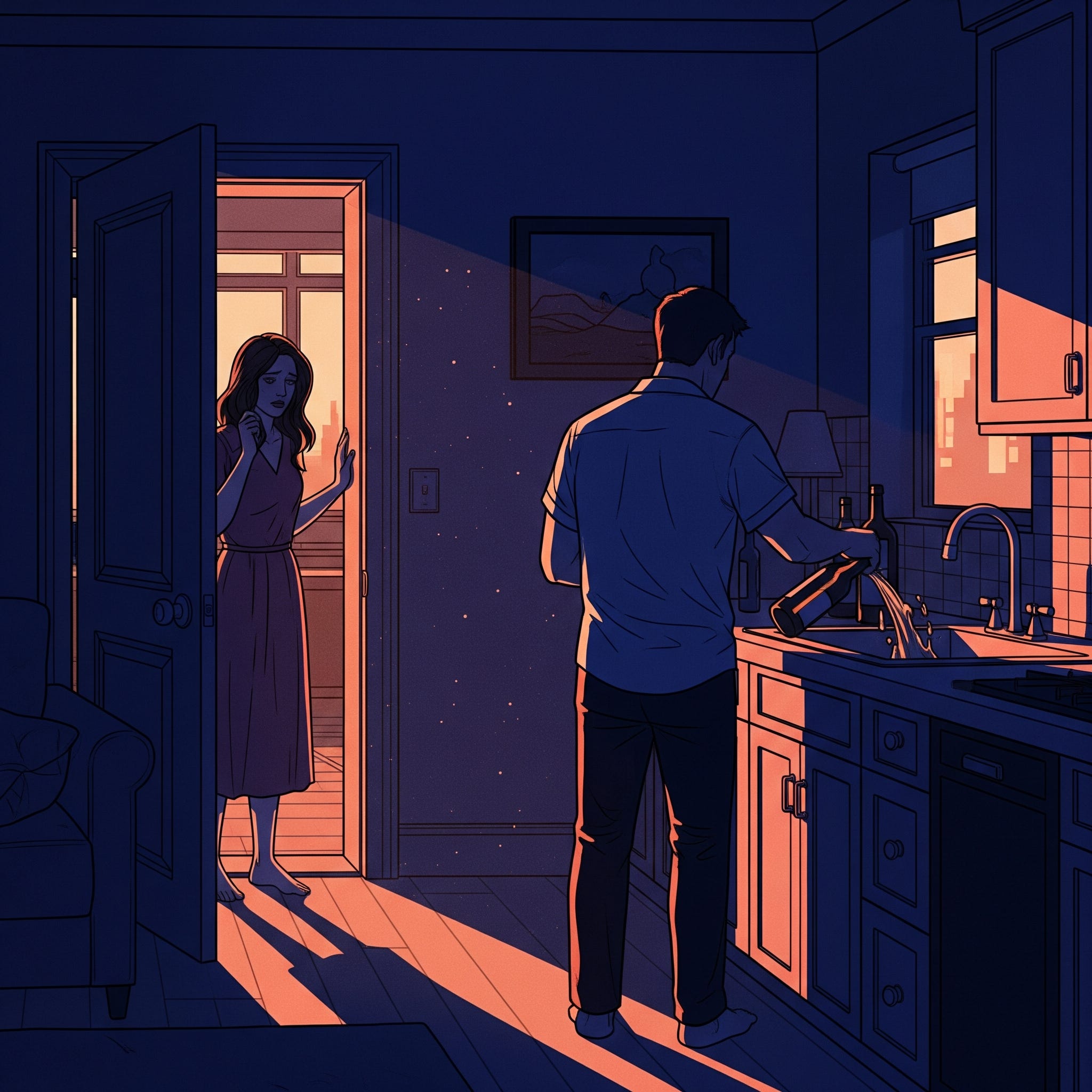
Symbolically, pouring out the contents of a kitchen is one of the most literal undoings imaginable: The accumulated supplies of a shared life — the things bought together for meals that would never be cooked again — being emptied, slowly, by one person while the other works in the next room. The image holds the entire ending in a single gesture. No wonder it stayed with me for so long.
It is also doing something else. I was not in the kitchen the whole time, but the memory of my ex-husband standing in front of the sink remains unusually clear. That is often how it goes with the moments we were not fully present for: the mind reconstructs them later, in detail, almost as if to make up for the absence. The shame about not being there gets paid back, partially, by remembering the reconstructed scene more vividly than the reality.
The mechanism behind such avoidance
Freud called this parapraxis — the so-called Freudian slip. The contemporary frame is gentler and more empirical: psychologists now talk about motivated forgetting and avoidance behavior. The idea is that the mind protects itself from emotional content by quietly rerouting attention away from things that would hurt. The protection is not always conscious, and it is not always proportionate. Sometimes it saves a person from a difficulty they could not have managed in the moment. Other times it stops them from being present for something they later wish they had been present for.
The cleaning of a shared apartment after a marriage ends is exactly the kind of event the mind would want to look away from. It is not just logistics. It is the physical undoing of a life — bottle by bottle, drawer by drawer, room by room. Of course something in the system tried to arrange a different schedule.
Why guilt is the wrong response
The painful part of stories like mine is rarely the forgetting itself. It is the shame that comes afterward — the sense that my ex partner did the harder work alone, that I was somehow not equal to the moment, that the absence was a moral failure rather than an emotional limit.
In fact, it probably was the same self-protective mechanism that closes your eyes during a fall. The system did what it could to spare me from a scene it judged unbearable, but the shame caused by the memories of it, in the aftermath, does more harm than the original absence did.
From the distance of the years passed, it becomes possible to see the avoidance for what it was: not a verdict on character, but evidence of how much was being held.
What it doesn't mean
If something similar ever happened to you, it does not necessarily mean that you were a worse partner than the other because of not being able to face the cleaning (or whatever it was in your case). It does not mean the avoidance defines the person. People who can stay present through the hardest parts of an ending are not better humans — they are people whose particular protective mechanisms work differently, often at higher costs that the others do not see.
What it might mean is that there are scenes from the end of the marriage that need to be looked at carefully now, with kindness, in the way that was not possible at the time. Not to assign blame. Just to give those scenes a place to sit, where they are not still asking to be remembered.
A note on the ideas behind this post
Below you will find some “scientific” anchors, in case you want to add them to your further-reading section over time:
Parapraxis / Freudian slips: Freud’s The Psychopathology of Everyday Life (1901). Old, but the concept survives in popular usage.
Motivated forgetting / suppression: contemporary cognitive psychology (Michael Anderson’s work on the “think/no-think” paradigm is the most rigorous modern source).
Avoidance behavior in grief: George Bonanno again, plus Mardi Horowitz’s older work on “stress response syndromes” and the oscillation between intrusion and avoidance after loss.
Journaling is not only a way to steam your negative thoughts, but also a great source for more mature reflections, after the emotional part has been over.
I write these reflections while building Supportive Stranger, a small iOS app for journaling through difficult moments — where you write, a supportive stranger draws a quick visual (like the one above), and you decide whether to keep the entry or let it go.


